
People don’t ignore familiar ideas. They ignore something more specific than that.
They ignore familiar ideas presented in familiar ways.
And that’s the difference between a “red ocean” niche and a niche that’s just wearing the same outfit as everyone else.
Here’s 5 ways to make your digital products sell every single day in “ah man that’s too competitive” niches while everyone else is out there searching for blue oceans that don’t exist.
Strategy 1: Attach to what people already know, then add a fresh angle
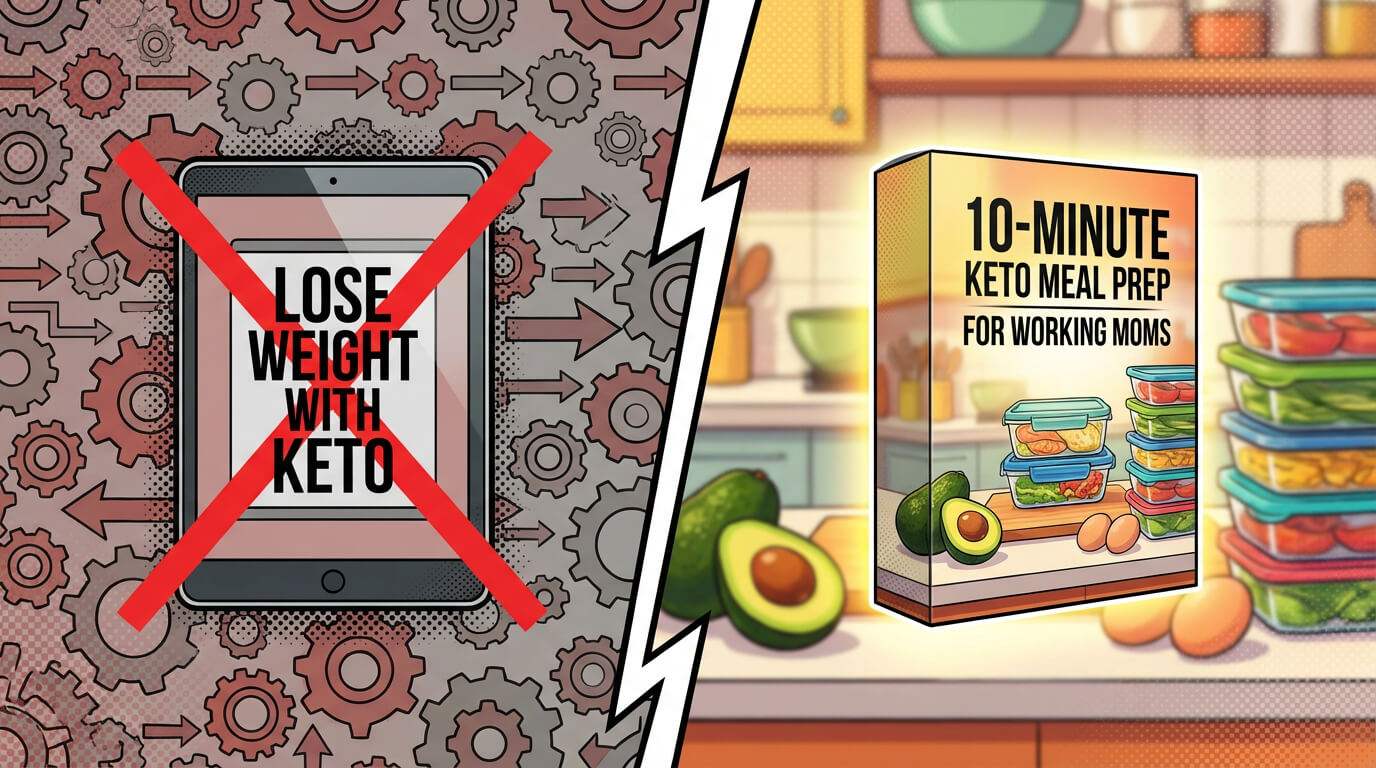
Take weight loss. Specifically, keto.
If you think keto is saturated, you might be right.
If you’re positioning it as “lose weight with keto,” you’re late to a party that ended a bajillion years ago.
But “10-Minute Keto Meal Prep for Working Moms”?
That’s keto (everyone knows it) + meal prep (specific subset) + speed modifier + audience qualifier. Same niche. Completely different positioning.
The product sells because keto is a Super-Signal.
(this is something I teach about in my private group)
People already believe in it. You’re not educating them on what keto is or why it works. You’re just showing them a version of it that actually fits their life.
You don’t gotta educate them on it – they have instant belief + built-in desire.
That’s the whole game.
Strategy 2: Solve a specific friction point instead of the general problem

Home workouts are everywhere.
Literally everyone and their personal trainer’s cousin has bought or tried some sort of home workout program.
But “Apartment-Friendly Resistance Band Workouts (No Jumping Required)”?
Now we’re cookin’ with butter 🧈
❌ That’s not solving “I want to work out at home.”
✅ That’s solving “I want to work out at home but my downstairs neighbor will murder me if I do one more burpee.”
(If you’ve ever lived in an apartment, you know exactly what I’m talking about.)
It’s the same Super-Signal (home workouts), same Sub-Signal (resistance bands), but the modifier (“no jumping” + “apartment-friendly”) turns a saturated niche into a specific solution for a real friction point people are actually dealing with.
The niche isn’t dead. The generic version of it is.
Strategy 3: Target a timeframe, not just a topic

Sleep advice is everywhere. Morning routines, night routines, sleep hygiene, blue light blocking, magnesium supplements, weighted blankets…
It’s all been said.
But what about…
“The 15-Minute Wind-Down Protocol for Anxious Minds”?
That’s sleep routines (Super-Signal) + pre-bed wind-down (Sub-Signal) + time modifier (15 minutes) + audience qualifier (anxious minds).
It’s not competing with every sleep product on the internet. It’s targeting a specific moment in the day where a specific type of person has a specific problem.
Same niche. Different lens.
And it works because you’re not asking someone to overhaul their entire life. You’re asking them to try something for 15 minutes before bed.
Pretty cool.
Strategy 4: Use my Perfect Position formula instead of fighting it
Here’s what most people do when they see saturation…
They try to invent something new.
❌ A new framework, a new concept, a new buzzword nobody’s heard of yet.
And then they wonder why nobody buys.
Let me explain.
The ones selling daily aren’t creating new awareness. They’re attaching to existing awareness and repositioning it.
The formula is simple:
Super-Signal (what people already know) + Sub-Signal (specific subset) + Modifiers (your unique angle)
- Keto → Meal Prep → 10-minute + Working Moms
- Home Workouts → Resistance Bands → No Jumping + Apartment-Friendly
- Sleep Routines → Wind-Down Protocol → 15-minute + Anxious Minds
Every “dead” niche has dozens of Sub-Signals. Every Sub-Signal has infinite modifier combinations.
You’re not looking for a new niche. You’re looking for a new way to talk about the same one.
Strategy 5: Stop when it works instead of reinventing
The biggest mistake isn’t picking a saturated niche. It’s abandoning it the second you think it’s too crowded (or picking the wrong niche before you even start).
The smart folks that are crushing it in “red ocean” niches found one angle that works and kept it running.
❌ They didn’t pivot to a new niche every month.
❌ They didn’t chase trends.
❌ They didn’t try to outsmart the market.
They just positioned better than everyone else and let the formula do its thing.
Because here’s the truth most people miss…
(Read that again if you gotta.)
✅ Keto isn’t saturated. “Lose weight with keto” is.
✅ Home workouts aren’t too competitive. “Get fit at home” is.
✅ Sleep routines aren’t dead. “Sleep better” is.
The niche is fine. Your positioning is just wearing the same outfit as everyone else.
So change the fkn outfit.
Super-Signal + Sub-Signal + Modifiers.
That’s it.
✅ Find what people already know.
✅ Drill down to a specific subset.
✅ Add your angle.
And here’s how you can test it…
Do the grocery store test
If you can go into your grocery store and a random cashier immediately knows what you’re selling and who it’s for without have to ask a million questions, you’ve got a Super-Signal.
If it sounds fresh even though the topic is familiar, you’ve positioned it right.
And if you want the complete framework for how to do this with your offer, my Perfect Positioning Framework breaks all this stuff down. I’ll prob post about that soon.
Before you do that tho, you gotta find the right Super-Signal, and you do that by picking a profitable niche.